


The Research MED professional protocol that ensures intensive skin renewal to progressively improve texture, luminosity, and uniformity, and reduce visible signs of aging.
ACTION
A non-invasive procedure of active exfoliation and biological regeneration, acting on all signs of skin aging. Designed to offer results comparable to those sought with laser, without using laser technology, it renews, reactivates, and regenerates the skin deeply through a keratolytic principle of mechanical nature.
WITH: PDRN biotech · Functionalized Spicules · Retinol · Vitamin C · Ferulic Acid
DURATION: 20 MINUTES
Thickened or keratinized
Dull, lackluster, and uneven skin texture
With superficial spots and dyschromias
With visible pores and post-imperfection marks
Seborrheic or tending to oily
Your goal is to improve skin texture, luminosity, and skin uniformity by eliminating spots, dyschromias, and signs of aging with a “corrective” and structured superficial renewal action.


T0: before the procedure / T1: after 5 days / T2: after 7 days
 T0
T0
T0
T0
 T1
T1
T1
T1
Aging and dyschromias
 T2
T2
T2
T2
Aging and dyschromias


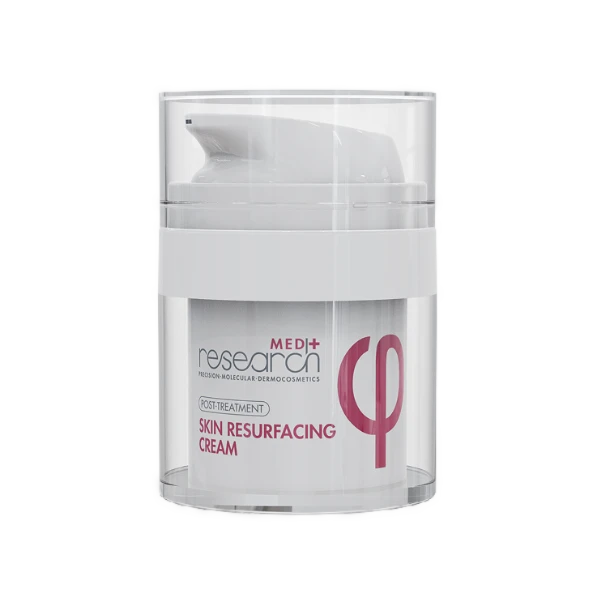

Skin resurfacing cream
The homecare treatment that promotes skin surface renewal and cellular turnover, for progressively smoother, more uniform, and radiant skin.
With: PDRN biotech · Hyaluronic Acid · AHA · PHA · Bioengineered microneedles
Discover all home care productsWhat is Skin Resurfacing?
Skin Resurfacing is an outpatient protocol of controlled keratolytic exfoliation, without the use of needles or devices. It combines high-concentration spicules, Ascorbic Acid, Ferulic Acid, microencapsulated Retinol and PDRN.
In which cases is Skin Resurfacing indicated?
The treatment is indicated for manifestations of chronological and photo-induced skin ageing, in the presence of wrinkles, dyschromias and irregularities of the skin texture.
Is a preliminary assessment necessary?
Yes. Before the treatment, a clinical assessment is planned, necessary to verify the indication and define the most appropriate protocol according to the characteristics and conditions of the skin.
What instructions should be followed before the session?
In the week preceding the treatment it is advisable to avoid scrubs, waxing in the area to be treated and intense sun exposure. The use of topical retinoids and exfoliating products must be suspended in the days before the session, according to the instructions provided by the physician.
How does the session take place?
The protocol is structured through the application of the Keratolytic Powder Functionalised Facial Spicules and the Facial PDRN Fluid, followed by the Facial EGF Pack.
Is the treatment painful?
The treatment is generally well tolerated. During the session a rubbing sensation related to the high concentration of spicules may be perceived. The intensity is modulated according to skin sensitivity, particularly during the first sessions.
How long does the session last?
The duration of the treatment is 20 minutes.
What instructions should be followed in the days following the treatment?
In the 7 days following the treatment it is recommended to avoid direct sun exposure, and in the 21 days following the treatment it is necessary to regularly apply the Skin Defense SPF 50 photoprotection. If desquamation occurs, it is important not to remove or rub the affected areas manually, but to allow the physiological spontaneous detachment of the superficial skin layer. For the following 21 days, it is advisable to suspend the home use of products or devices with exfoliating action, both chemical and mechanical, and to avoid exposure to UV lamps. During the post-treatment phase, the post-procedural home treatment Deep Recovery must be used, according to the recommended modalities.
What reactions may appear after the treatment?
In the hours following the session, erythema and a transient sensation of heat may appear, with variable intensity related to the exfoliating action and the individual skin response. In the following days, skin desquamation may also occur. Complete restoration of the stratum corneum generally takes place within an interval of 3 to 7 days. In more sensitive skins, the reaction may be more evident, progressively attenuating in the following days.
Is it possible to resume normal activities immediately?
Yes. In most cases no recovery times are expected that would prevent the resumption of normal daily activities. The intensity and duration of post-treatment manifestations may however vary in relation to the individual characteristics of the skin.
When is it possible to apply make-up?
It is advisable to avoid the application of covering cosmetic products immediately after the session. The resumption of make-up is indicated according to the skin response and the post-treatment course.
Is it possible to practise sports or use saunas and steam baths?
In the 72 hours following the treatment it is advisable to avoid sauna, steam bath, intense physical activity and any other condition that causes a significant increase in sweating and skin temperature.
Can the treatment be performed close to an important event?
Yes. It is however advisable to schedule the treatment at least 2 weeks in advance of the event, in consideration of the time required for complete restoration of the stratum corneum.
In which cases is it advisable to contact the clinic after the treatment?
It is advisable to contact the clinic if skin reactions of intensity or duration greater than expected in the normal post-treatment course appear, such as persistent burning, marked oedema, appearance of vesicles or intense itching.
How many sessions are generally planned?
Skin Resurfacing can be performed as a single session, with a maximum frequency of one per month and an indicative total of four sessions per year. The number of sessions and the related interval are defined by the professional according to the phototype and skin characteristics.
When do the results become visible?
An improvement in skin quality may be appreciable as early as 3-4 days after the first session. The effects become progressively more evident and may vary according to the starting skin condition.
How long do the results last over time?
The duration of the results is variable and depends on several individual factors, including age, skin characteristics, sun exposure and lifestyle. Any maintenance sessions and an adequate home routine with the Skin Resurfacing Cream can help preserve the obtained skin quality over time.
Can the treatment be performed during the summer period?
It is preferable to schedule Skin Resurfacing outside the summer period, when sun exposure is generally more limited. The most appropriate timing is defined by the physician according to the phototype, skin conditions and individual sun exposure habits.
Can the treatment be combined with other protocols?
Yes. Skin Resurfacing can be included within integrated programmes and alternated with other protocols, including Skin Quality, according to a schedule defined by the professional.
In which cases is the treatment not indicated?
The treatment is not indicated in case of:
Copyright ©2026 Dermosfera S.r.l. • Via Commenda 3/A, 40068, San Lazzaro di Savena (BO) • Partita IVA 00633561204